Starting up a blog then going silent for weeks. Excellent start. I have an excuse- I moved out last month. As it turns out, moving out is a fairly stressful and time consuming process.
I have some content, hopefully fun and/or useful, coming soon, but "soon" is a vague word. It'll happen when it happens, no worries. : )
I... don't know if anyone is actually following this blog yet. Probably not! But if you are, this post is for you!
Keep on playing tabletop games!
- PK
Monday, June 24, 2019

Monday, June 3, 2019
Into the BLAME! (WIP Name)- session 1
As far as campaign names go, Into the Blame! is probably about as bad as they get. I put this game together in the span of an hour before the game, though I had the general concept floating in my head for awhile.
I used Into the Odd on a whim, having never played it before.The setting is basically just Tsutomu Nihei's BLAME! manga, but adapted ever so slightly to OSR gaming. Players will have to navigate a post-post-apocalyptic cyberpunk urban hellscape where earth is but a legend and the sky has never been seen, because everyone is trapped in an endless metal megastructure. The world is the dungeon.
Of course, Into the Odd is more steampunk weirdness and isn't quite a perfect mix with what I was trying to do, but that's ok, because I started it out with the characters waking up in the middle of the dungeon with no idea what was going on, having been abducted from Bastionland.
The Party
Awakening
So the two characters, Lailah and Kryle, both woke up on an uncomfortable bed, wearing nothing. They had been cryogenically frozen. Thankfully, they quickly found a closet of generic uniforms similar to that worn by the Vault-dwellers of Fallout, as well as a few things they owned. Lailah owned a Mule, which also had it's own cold sleep bed. Kryle owned a rocket, no rocket launcher included. The player was absolutely thrilled at this chargen result.
Leaving the Bay of the Sleepers, the characters stepped through an automatically opening door into the next room. The walls were made of featureless white plastic, and the room was mostly unadorned, it would have been quite boring if not for the corpse in the middle of it, wearing a generic uniform, being eaten by a robotic wolf. The canine immediately ran down a hallway to the west, and the duo paused only to check the corpse for gear- they found a knife. As both had started with pistols, the melee weapon was a reasonable find, and Kryle kept it. They followed the dog cautiously as it ran around the corner, checking doors in the hallway as they went.
In one room they encountered a man, just standing there with his back to them. Lailah shot him in the back of the head, an action that Kryle did not appreciate, at least until the man turned around, revealing that his skin was melting off a half-cyborg head. At this point both Lailah AND Kryle unloaded into the man, and he went down. It wasn't until they had searched his corpse that they realized he had not actually done anything hostile, but shrugged this off.
Following around the corner, Lailah used an Arcanum she had started with- the Heart Locket- to find the location of the wolf, which had disappeared. While Kryle was dragging the mule around the corner, Lailah entered the door the wolf was hiding behind, and found three of it's friends. They jumped her and dragged her to the ground, but she made her pistol explode, destroying one... and killing herself in the process.
Kryle rode the mule into the group of four wolves, intending to suicide with his rocket, jumping down onto the ground with the rocket. Unfortunately, it turned out to be a bit of a dud, not having nearly the destructive potential it should have had (only 5 damage on that delicious d12), and Kryle avoided taking lethal injuries from the blast. The robots avoided destruction as well, but they retreated from combat, to the south.
The Life and Death of a "Wall"
While investigating the lair of the wolves (finding a few cred-sticks, the currency of this world), Kryle was joined by another woman, who burst out from a wall. She didn't explain herself, but said that "she had already had a very long day". They moved south, where the wolves had fled- only to hear the sound of bullets tearing into metal. Glancing around the corner of the hallway, they saw a turret, smoke rising from the machine gun attached to it, and the destroyed remains of three robot wolves. The new arrival, known only as "Wall", tossed a grenade at the turret, blowing it up. They discovered that the turret had been guarding a nice cache of explosives and gear, including body armor that was similar to SWAT gear, and another rocket(!).
Beyond this guard station, they found a heavy duty shut door that would not open. They considered using the mule to deliver all their explosives and destroy the door, but found a side passage, which contained odd tubes with chairs in them. The tubes led out of the room, into a dark tunnel. After much deliberation, Wall sat in one of the chairs, and with a zooming noise, she was gone. Kryle panicked, and waited for her return. She did not.
Wall had entered a network of fast transport tubes that zipped over a vast cavern. Unfortunately, they were very badly maintained, and had a giant hole in them. The chair flew out of the tube, and Wall was not dexterous enough to grab onto anything before becoming a stain upon the ground.
Lunchroom
Kryle eventually returned the way he came, all the way back to the room where they had first encountered the robot dog. He went south this time, and found himself in a room with plastic tables and three machines along the wall. Here he was met by yet another cold-sleeper who had awoken, with the name of Jai. They examined the machines, and found one was a vending machine- it only had a few items left, and demanded obscene amounts of credits for the purchases. The new arrival remembered her handy dandy bolt-cutters, and broke open the machine, getting several medical syringes filled with healing serum, a few grenades, and a can of lemonade (perfect for bribing security guards!).
They moved onto the next machine, which, long story short, was essentially an ATM. They broke into this machine as well, and coins came falling out, more coins than they could ever carry.
The final machine was built into the wall, and materialized food, Star Trek style. Unfortunately, the food was rotten.
Kryle searched for something adhesive, and actually found it! On the underside of one of the tables, was another healing syringe duct taped to the table. He used this tape to attach coins to a grenade, creating a poor man's fragmentation grenade.
Jai and Kryle proceeded south, and found two paths. One led to a room flooded with a silvery liquid on the floor (the players could not resist labeling this room as, uh, "jizz".) They did not touch it. The other path led to a small spiral staircase, that led downwards, into the lower floor(s?) of the facility. What would they find there? What secrets would they discover? How many more characters would the player known as "N" burn through? Find out next time, should this game continue beyond session 1!
Casualties:
Lailah, level 1, death by robot dogs
Wall, level 1, death by falling out of a fast transport tube
Commentary:
This worked out very remarkably well, given how little time I had to prepare it. There was a distinct lack of random encounters thanks to me forgetting that bit of prep, but the session was still eventful... and lethal. One of my players is very happy to treat characters as game pieces to be used recklessly and discarded easily. The robot wolves were foreshadowed hard and the players had no excuse. The death via transportation tube was a result of a critical failure on a save- if it weren't for that, she would have just taken some damage from a fall. We both agreed this was how it should turn out.
I allowed the players to destroy a turret without even rolling damage. I felt the grenade was the perfect solution to the problem. Because of this, they were able to get a very nice set of loot early. The actual loot was a bit of a mess - I don't have a full set of items for this world yet, so there was lots of healing syringes, grenades, and credsticks.
The mule survived to the end of the session, and that makes me happy. It is the single most out of place element, all thanks to Into the Odd random starting item tables!
As a system, Into the Odd was simple. A little too simple. Despite having a higher page count than Knave, it ended up being even more simple in practice- three saves + hp, limited starting inventory, and that's pretty much it. The starting kits are a lot of fun, lots of flavor to the starting items, but otherwise there's very little fuel to be used for key details about the characters themselves, unlike Knave. There's no backgrounds, no classes, and no real statistical different besides HP and saves.
See, with no attack rolls being made, character's attributes no longer inform their effectiveness at melee vs ranged damage. Higher will characters are better at using arcanum in unconventional ways, but that's the only difference as far as spells are concerned. The game, then, is not only classless, it's also practically statless, at least when it comes to determing who is better than other people at tasks. Knave is classless but still has some texture when it comes to attributes- some characters lean in certain directions.This is not necessarily a bad thing, but it does mean characters are very samey, even on a mechanical level.
I'm all for building characters via play, and Kryle in particular became a fairly interesting guy, due to his love of rockets and trauma from witnessing two deaths. But overall, I can see why Chris McDowall is working on the sequel to Into the Odd, Electric Bastionland, which has evocative backgrounds as a core feature. That should at least give players something to grab onto.
I will likely continue using Into the Odd for the next session as they explore the abandoned Cryosleep Facility, but intend to eventually develop my own system, probably based on either B/X or Knave, that will allow for characters native to this world, instead of Bastionland rejects that somehow woke up here. A central theme of the system will be cybernetic augmentation and biological mutation. Fun times ahead!
I used Into the Odd on a whim, having never played it before.The setting is basically just Tsutomu Nihei's BLAME! manga, but adapted ever so slightly to OSR gaming. Players will have to navigate a post-post-apocalyptic cyberpunk urban hellscape where earth is but a legend and the sky has never been seen, because everyone is trapped in an endless metal megastructure. The world is the dungeon.
Of course, Into the Odd is more steampunk weirdness and isn't quite a perfect mix with what I was trying to do, but that's ok, because I started it out with the characters waking up in the middle of the dungeon with no idea what was going on, having been abducted from Bastionland.
The Party
- Kryle, the Rocket Man (level 1)
- Lailah, the one with the Mule (level 1)
- A Mule, the beast of burden (level 1 follower)
Awakening
So the two characters, Lailah and Kryle, both woke up on an uncomfortable bed, wearing nothing. They had been cryogenically frozen. Thankfully, they quickly found a closet of generic uniforms similar to that worn by the Vault-dwellers of Fallout, as well as a few things they owned. Lailah owned a Mule, which also had it's own cold sleep bed. Kryle owned a rocket, no rocket launcher included. The player was absolutely thrilled at this chargen result.
Leaving the Bay of the Sleepers, the characters stepped through an automatically opening door into the next room. The walls were made of featureless white plastic, and the room was mostly unadorned, it would have been quite boring if not for the corpse in the middle of it, wearing a generic uniform, being eaten by a robotic wolf. The canine immediately ran down a hallway to the west, and the duo paused only to check the corpse for gear- they found a knife. As both had started with pistols, the melee weapon was a reasonable find, and Kryle kept it. They followed the dog cautiously as it ran around the corner, checking doors in the hallway as they went.
In one room they encountered a man, just standing there with his back to them. Lailah shot him in the back of the head, an action that Kryle did not appreciate, at least until the man turned around, revealing that his skin was melting off a half-cyborg head. At this point both Lailah AND Kryle unloaded into the man, and he went down. It wasn't until they had searched his corpse that they realized he had not actually done anything hostile, but shrugged this off.
Following around the corner, Lailah used an Arcanum she had started with- the Heart Locket- to find the location of the wolf, which had disappeared. While Kryle was dragging the mule around the corner, Lailah entered the door the wolf was hiding behind, and found three of it's friends. They jumped her and dragged her to the ground, but she made her pistol explode, destroying one... and killing herself in the process.
Kryle rode the mule into the group of four wolves, intending to suicide with his rocket, jumping down onto the ground with the rocket. Unfortunately, it turned out to be a bit of a dud, not having nearly the destructive potential it should have had (only 5 damage on that delicious d12), and Kryle avoided taking lethal injuries from the blast. The robots avoided destruction as well, but they retreated from combat, to the south.
The Life and Death of a "Wall"
While investigating the lair of the wolves (finding a few cred-sticks, the currency of this world), Kryle was joined by another woman, who burst out from a wall. She didn't explain herself, but said that "she had already had a very long day". They moved south, where the wolves had fled- only to hear the sound of bullets tearing into metal. Glancing around the corner of the hallway, they saw a turret, smoke rising from the machine gun attached to it, and the destroyed remains of three robot wolves. The new arrival, known only as "Wall", tossed a grenade at the turret, blowing it up. They discovered that the turret had been guarding a nice cache of explosives and gear, including body armor that was similar to SWAT gear, and another rocket(!).
Beyond this guard station, they found a heavy duty shut door that would not open. They considered using the mule to deliver all their explosives and destroy the door, but found a side passage, which contained odd tubes with chairs in them. The tubes led out of the room, into a dark tunnel. After much deliberation, Wall sat in one of the chairs, and with a zooming noise, she was gone. Kryle panicked, and waited for her return. She did not.
Wall had entered a network of fast transport tubes that zipped over a vast cavern. Unfortunately, they were very badly maintained, and had a giant hole in them. The chair flew out of the tube, and Wall was not dexterous enough to grab onto anything before becoming a stain upon the ground.
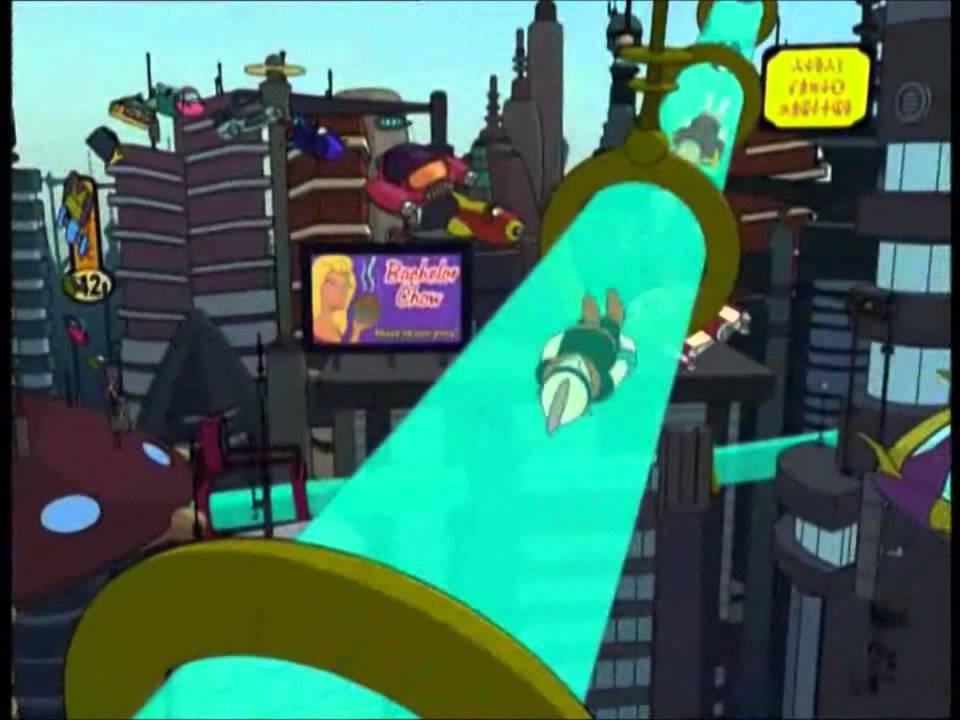 |
| Like this, but with a chair, and more ruined, and more bodies at the bottom of it. |
Lunchroom
Kryle eventually returned the way he came, all the way back to the room where they had first encountered the robot dog. He went south this time, and found himself in a room with plastic tables and three machines along the wall. Here he was met by yet another cold-sleeper who had awoken, with the name of Jai. They examined the machines, and found one was a vending machine- it only had a few items left, and demanded obscene amounts of credits for the purchases. The new arrival remembered her handy dandy bolt-cutters, and broke open the machine, getting several medical syringes filled with healing serum, a few grenades, and a can of lemonade (perfect for bribing security guards!).
They moved onto the next machine, which, long story short, was essentially an ATM. They broke into this machine as well, and coins came falling out, more coins than they could ever carry.
The final machine was built into the wall, and materialized food, Star Trek style. Unfortunately, the food was rotten.
Kryle searched for something adhesive, and actually found it! On the underside of one of the tables, was another healing syringe duct taped to the table. He used this tape to attach coins to a grenade, creating a poor man's fragmentation grenade.
Jai and Kryle proceeded south, and found two paths. One led to a room flooded with a silvery liquid on the floor (the players could not resist labeling this room as, uh, "jizz".) They did not touch it. The other path led to a small spiral staircase, that led downwards, into the lower floor(s?) of the facility. What would they find there? What secrets would they discover? How many more characters would the player known as "N" burn through? Find out next time, should this game continue beyond session 1!
 |
| Kryle by the end of the session, equipped with machine gun and body armor. Not sure of the source, the player found it, not me. |
Casualties:
Lailah, level 1, death by robot dogs
Wall, level 1, death by falling out of a fast transport tube
Commentary:
This worked out very remarkably well, given how little time I had to prepare it. There was a distinct lack of random encounters thanks to me forgetting that bit of prep, but the session was still eventful... and lethal. One of my players is very happy to treat characters as game pieces to be used recklessly and discarded easily. The robot wolves were foreshadowed hard and the players had no excuse. The death via transportation tube was a result of a critical failure on a save- if it weren't for that, she would have just taken some damage from a fall. We both agreed this was how it should turn out.
I allowed the players to destroy a turret without even rolling damage. I felt the grenade was the perfect solution to the problem. Because of this, they were able to get a very nice set of loot early. The actual loot was a bit of a mess - I don't have a full set of items for this world yet, so there was lots of healing syringes, grenades, and credsticks.
The mule survived to the end of the session, and that makes me happy. It is the single most out of place element, all thanks to Into the Odd random starting item tables!
As a system, Into the Odd was simple. A little too simple. Despite having a higher page count than Knave, it ended up being even more simple in practice- three saves + hp, limited starting inventory, and that's pretty much it. The starting kits are a lot of fun, lots of flavor to the starting items, but otherwise there's very little fuel to be used for key details about the characters themselves, unlike Knave. There's no backgrounds, no classes, and no real statistical different besides HP and saves.
See, with no attack rolls being made, character's attributes no longer inform their effectiveness at melee vs ranged damage. Higher will characters are better at using arcanum in unconventional ways, but that's the only difference as far as spells are concerned. The game, then, is not only classless, it's also practically statless, at least when it comes to determing who is better than other people at tasks. Knave is classless but still has some texture when it comes to attributes- some characters lean in certain directions.This is not necessarily a bad thing, but it does mean characters are very samey, even on a mechanical level.
I'm all for building characters via play, and Kryle in particular became a fairly interesting guy, due to his love of rockets and trauma from witnessing two deaths. But overall, I can see why Chris McDowall is working on the sequel to Into the Odd, Electric Bastionland, which has evocative backgrounds as a core feature. That should at least give players something to grab onto.
I will likely continue using Into the Odd for the next session as they explore the abandoned Cryosleep Facility, but intend to eventually develop my own system, probably based on either B/X or Knave, that will allow for characters native to this world, instead of Bastionland rejects that somehow woke up here. A central theme of the system will be cybernetic augmentation and biological mutation. Fun times ahead!
Wednesday, May 15, 2019
Potions
Quite a few retroclones make use of the idea that you can identify potions by sipping them, allowing quick identification at the cost of potentially exposing yourself to poison or worse. I like this idea, though in practice my players have not bit- they're genre savvy enough to know what happens.
I was playing a roguelike called Dungeon Crawl, and the mechanic sort of clicked for me- in that game, you accumulate unknown potions with very specific colors- the colors are randomized at the beginning of a game. So when you have 10 potions of one color, it suddenly becomes an ok deal to risk the atrophication of your limbs in order to have a very common potion known. Indeed, in that game you build a collection of known colors. Consistency is key- if you're being consistent with your potion descriptions, sipping should become slightly less of a fool's deal.
So, I put together a quick set of tables to roll on for basic descriptions. And, since I'm in dire need of content for this blog, I'm posting it here. You don't need to completely randomize your potions- indeed, it may make sense to have a potion of water breathing blue and smell like the sea, so do that. This is more for when you draw up a potion as loot and need a quick prompt to describe it. These are not, generally speaking, evocative descriptions, like the kind you might get from Patrick Stuart. They are short and to the point.
Roll on as many of the tables as you want to. Roll a d10 to confine yourself to what I arbitrarily considered "basic" colors, or a d20 to have a larger variety.
Just, write down what you get for each potion, so you can be consistent in the future.
Basic Potion Colors (d10)
1. Red
2. Blue
3. Yellow
4. Green
5. Orange
6. Purple
7. White
8. Black
9. Grey
10. Clear
Advanced Potion Colors (d20)
11. Brown
12. Teal
13. Pink
14. Gold
15. Silver
16. Bronze
17. Magenta
18. Rust
19. Crimson
20. Rainbow
Modifications (d8)
1. Gold/ Silver Flecks
2. Contains tooth/bone/rat tail/toenail/ other gross detail
3. Light [Color]
4. Dark [Color]
5. Smokey or Faded
6. Two Basic Colors Swirled together
7. Fizzy
8. Thick, like the consistency of Yogurt
Smells (d12)
1. Like fresh water
2. Completely Odorless
3. Acidic or Sulfuric
4. Delicious
5. Absolutely Nasty, like a toilet or something.
6. Like Perfume
7. Flowers or Pine
8. Like Alcohol
9. Like Smoke
10. Nostalgic
11. Like Tree Sap
12. Like the Sea
Not a huge fan of the smells in their current state, but they'll do.
Taste (d6)
1. Tasteless
2. Hearty, like soup broth
3. Bitter / Sour
4. Sweet
5. Spicy, like drinking tabasco
6. Like Alcohol.
By the time they taste it, it's too late to identify. So this last table is just for if they ask.
Other Identification Methods
Here is what I allow.
- Someone with an alchemist class or background should automatically know most basic types of potions, and should be able to make an INT check for more niche potions. I love rewarding backgrounds.
- Paying an Alchemist or Wizard for their identification. Be arbitrary with prices, drain your player's gold away!
- Looking at an alchemist's wares to figure out the colors of potions being sold. 25% chance the item is mislabeled, by accident or malice- such mislabeling would naturally be corrected at purchase, but an alchemist isn't going to do much for window shopping.
-Spending valuable downtime doing research. Maybe a week per potion?
- Spells of Identification, if they exist. I limit these most of the time.
- Test on hirelings. Hirelings are not PCs, and may not know exactly what it does from a sip, but they can provide hints. If they don't drop dead.
- Test on animals. Animals cannot talk in most cases, but this test will at least determine if it is lethal or not. This is not something good, well adjusted adventurers do.
- For basic potions of healing, skip this whole song and dance. The characters are competent and know what healing potions look like.
So ultimately, I doubt anyone is going to sip unknown potions... but there should be a lot of pressure to do so. It should be really tempting. Especially if you get one in the middle of the dungeon while your resources are running dry.. Maybe someone will break. And it'll turn out fine, because most potions are fine. So they'll taste test more and more... until one day, their luck runs out.
---
One last note: I am sure I am not the first person to create something like this. If you know of similar pages, please let me know!
Friday, May 10, 2019
Slot based Inventory
(Note: Scroll to the bottom of the post for full system minus commentary)
I keep seeing posts about Slot based inventory systems. Which is weird, since in the OSR space I inhabit encumbrance is more or less solved.
Don't use weight. Weight is bad. Might as well not track items at all. Use inventory slots.
The basic solution goes like this:
"You get a number of inventory slots equal to STR or CON. Each item takes up 1 slot. Some items take up 2 or more slots. Small items may be bundled, and some items are insignificant and can be ignored."
Bam. Simple. Elegant. Except we gotta make some definitions. Because that by itself is vague and wishy-washy and while that may suit some people, some other important people, like your players, may potentially get stressed out about needing to ask all the time about the details. So we gotta flesh out the rule a little bit:
Medium Armor takes 2 slots. Heavy Armor takes 3 slots.
Two handed weapons take 2 slots, as do 10 foot poles and other unwieldy items.
Insignificant items are like, tiny items. A single unenchanted ring. A pruning knife.
What about bundling? This gets tricky. I've settled on the following two rules, which are by no means standard:
Rule of 3: Any item that more or less fits into your hand may be bundled into sets of three.
Specialized Containers: If you have a special container for an item type, it may be bundled up in sets of five. Ammo allows you to carry sets of 10.
(Suddenly, Spell Scrolls and Potion Bags are very, very useful!)
(Also, don't track ammo unless it is magical. Buy a quiver, go crazy. It is so, so very rare that mundane ammo numbers matter.)
At this point some people are done. But others look at this and are like "woah we can only carry up to our STR? That's almost nothing".
One response is "use hirelings". To a degree, that's my response too, but encumbrance is fun and useful in it's own way. So, super simple encumbrance rules.
You can carry a number of items up to STR x2 while encumbered. If encumbered, you move at half speed and have disadvantage on checks requiring physical ability, like climbing, swimming, jumping.
This may be a little overly harsh, but it's better than my base rule would be. Yora at Spriggan's Den has a three tiered encumbrance system that is much more forgiving for players, but requires you to actually calculate exact movespeed, which I don't actually do. Different strokes for different folks, it's a fine system. In any case, I recommend hirelings and pack animals if you don't want to deal with the penalties. (PS: I grabbed the idea of Insignificant items from Yora's post just now, I'd been grappling with a term to describe them and now I have it!)
So, lets put these rules all together!
---
The Encumbrance System to End All Encumbrance systems
You get a number of inventory slots equal to STR. Each item takes up 1 slot. Some items take up 2 or more slots. Small items may be bundled, and some items are insignificant and can be ignored.
Medium Armor takes 2 slots. Heavy Armor takes 3 slots.
Two handed weapons take 2 slots, as do 10 foot poles and other unwieldy items.
Insignificant items are like, tiny items. A single unenchanted ring. A pruning knife.
Rule of 3: Any item that more or less fits into your hand may be bundled into sets of three. Potions, Scrolls, Rations, and Torches count, even though Torches are large.
Specialized Containers: If you have a special container for an item type, it may be bundled up in sets of five. Ammo allows you to carry sets of 10. Don't track mundane ammo.
You can carry a number of items up to STR x2 while encumbered. If encumbered, you move at half speed and have disadvantage on checks requiring physical ability, like climbing, swimming, jumping.
----
Oh no, that's 4 paragraphs, wasn't this supposed to be simple?
In our quest to create super rules-lite gameplay, we sometimes get stuck on short length to the point where it's harmful. Most of what is here should be very intuitive, but will dramatically cut down on player questions and stress. It's worth the space, IMO. Anything that you cut will need to be talked about, probably over and over. I'd still consider this super simple and elegant compared to most inventory systems.
---
So how do you visually represent this on your page?
Have an inventory page as an example. Let's say you have 9 STR.
*1) BIG 2H SWORD
*2) XXXXXXXX
*3) [3 POTIONS- Healing, Invisibility, Unidentified]
4) LEATHER ARMOR
5) LARGE GOLD STATUE
6) XXXXXXXXX
7) XXXXXXXXX
8) XXXXXXXXX
9) [SCROLL CASE (5/5): Magic Missile x2, Locate Object, Cure Wounds, Fireball]
I use XXXX's to represent slots that are used, but you can use anything that makes it obvious the slot is taken. I use brackets here to indicate items that are bundled together. Allcaps is optional.
The * refer to quick slots- I use one more rule, you get a number of quick slots equal to your DEX mod, which can be freely equipped mid battle with no action loss. I like this rule but it's really optional so this is the only place I'll mention it.
---
As a player, I enjoy this system to no end. I love my equipment mattering, I love the feeling of my armor class going through the roof as I decide I don't need free slots when plate mail and shields exist. I love knowing exactly how much I can carry, without worrying that I messed up my math, because I am bad at math.
I recognize not all players are going to be so thrilled, but if they can't handle this, I can't see them doing well with ANY inventory system.
---
One final consideration: The question of unusually low strength.
In an old school OSR game (as opposed to newfangled "adventure" games like Knave), this will suck if you roll a 3 STR or something. It's always going to suck in that case, but in a "weight" game it's easier to cheat since no one is keeping track anyway. In this system, it's going to be really obvious how little you can carry.
I like allowing the following rule in character creation: 3d6 in order, but reroll one stat or swap two. If you get really STR screwed, this gives you enough leeway to hopefully fix it. Some characters are doomed, but most should be able to get at least 8-9 STR one way or another. Of course, you may not want to spend that reroll on STR, but it's an option, and hard choices are the heart of the game!
---
Your mileage may vary on the details. There are options here, ways to tweak it, and I'm not going to say my way is the best way. But I will defend inventory slots as a general concept to my grave, this is the hill I will die on!
---
Here's my rules again, so that they're easily found at the bottom of the post. I am assuming a normal OSR system, but these have been tested with GLOG and Knave and probably could even work with something like 5E:
You get a number of inventory slots equal to STR. Each item takes up 1 slot. Some items take up 2 or more slots. Small items may be bundled, and some items are insignificant and can be ignored.
Medium Armor takes 2 slots. Heavy Armor takes 3 slots.
Two handed weapons take 2 slots, as do 10 foot poles and other unwieldy items.
Insignificant items are like, tiny items. A single unenchanted ring. A pruning knife.
Rule of 3: Any item that more or less fits into your hand may be bundled into sets of three. Potions, Scrolls, Rations, and Torches count (even though Torches are large).
Specialized Containers: If you have a special container for an item type, it may be bundled up in sets of five. Ammo allows you to carry sets of 10. Don't track mundane ammo.
You can carry a number of items up to STR x2 while encumbered. If encumbered, you move at half speed and have disadvantage on checks requiring physical ability, like climbing, swimming, jumping.
I keep seeing posts about Slot based inventory systems. Which is weird, since in the OSR space I inhabit encumbrance is more or less solved.
Don't use weight. Weight is bad. Might as well not track items at all. Use inventory slots.
The basic solution goes like this:
"You get a number of inventory slots equal to STR or CON. Each item takes up 1 slot. Some items take up 2 or more slots. Small items may be bundled, and some items are insignificant and can be ignored."
Bam. Simple. Elegant. Except we gotta make some definitions. Because that by itself is vague and wishy-washy and while that may suit some people, some other important people, like your players, may potentially get stressed out about needing to ask all the time about the details. So we gotta flesh out the rule a little bit:
Medium Armor takes 2 slots. Heavy Armor takes 3 slots.
Two handed weapons take 2 slots, as do 10 foot poles and other unwieldy items.
Insignificant items are like, tiny items. A single unenchanted ring. A pruning knife.
What about bundling? This gets tricky. I've settled on the following two rules, which are by no means standard:
Rule of 3: Any item that more or less fits into your hand may be bundled into sets of three.
Specialized Containers: If you have a special container for an item type, it may be bundled up in sets of five. Ammo allows you to carry sets of 10.
(Suddenly, Spell Scrolls and Potion Bags are very, very useful!)
(Also, don't track ammo unless it is magical. Buy a quiver, go crazy. It is so, so very rare that mundane ammo numbers matter.)
At this point some people are done. But others look at this and are like "woah we can only carry up to our STR? That's almost nothing".
One response is "use hirelings". To a degree, that's my response too, but encumbrance is fun and useful in it's own way. So, super simple encumbrance rules.
You can carry a number of items up to STR x2 while encumbered. If encumbered, you move at half speed and have disadvantage on checks requiring physical ability, like climbing, swimming, jumping.
This may be a little overly harsh, but it's better than my base rule would be. Yora at Spriggan's Den has a three tiered encumbrance system that is much more forgiving for players, but requires you to actually calculate exact movespeed, which I don't actually do. Different strokes for different folks, it's a fine system. In any case, I recommend hirelings and pack animals if you don't want to deal with the penalties. (PS: I grabbed the idea of Insignificant items from Yora's post just now, I'd been grappling with a term to describe them and now I have it!)
So, lets put these rules all together!
---
The Encumbrance System to End All Encumbrance systems
You get a number of inventory slots equal to STR. Each item takes up 1 slot. Some items take up 2 or more slots. Small items may be bundled, and some items are insignificant and can be ignored.
Medium Armor takes 2 slots. Heavy Armor takes 3 slots.
Two handed weapons take 2 slots, as do 10 foot poles and other unwieldy items.
Insignificant items are like, tiny items. A single unenchanted ring. A pruning knife.
Rule of 3: Any item that more or less fits into your hand may be bundled into sets of three. Potions, Scrolls, Rations, and Torches count, even though Torches are large.
Specialized Containers: If you have a special container for an item type, it may be bundled up in sets of five. Ammo allows you to carry sets of 10. Don't track mundane ammo.
You can carry a number of items up to STR x2 while encumbered. If encumbered, you move at half speed and have disadvantage on checks requiring physical ability, like climbing, swimming, jumping.
----
Oh no, that's 4 paragraphs, wasn't this supposed to be simple?
In our quest to create super rules-lite gameplay, we sometimes get stuck on short length to the point where it's harmful. Most of what is here should be very intuitive, but will dramatically cut down on player questions and stress. It's worth the space, IMO. Anything that you cut will need to be talked about, probably over and over. I'd still consider this super simple and elegant compared to most inventory systems.
---
So how do you visually represent this on your page?
Have an inventory page as an example. Let's say you have 9 STR.
*1) BIG 2H SWORD
*2) XXXXXXXX
*3) [3 POTIONS- Healing, Invisibility, Unidentified]
4) LEATHER ARMOR
5) LARGE GOLD STATUE
6) XXXXXXXXX
7) XXXXXXXXX
8) XXXXXXXXX
9) [SCROLL CASE (5/5): Magic Missile x2, Locate Object, Cure Wounds, Fireball]
I use XXXX's to represent slots that are used, but you can use anything that makes it obvious the slot is taken. I use brackets here to indicate items that are bundled together. Allcaps is optional.
The * refer to quick slots- I use one more rule, you get a number of quick slots equal to your DEX mod, which can be freely equipped mid battle with no action loss. I like this rule but it's really optional so this is the only place I'll mention it.
---
As a player, I enjoy this system to no end. I love my equipment mattering, I love the feeling of my armor class going through the roof as I decide I don't need free slots when plate mail and shields exist. I love knowing exactly how much I can carry, without worrying that I messed up my math, because I am bad at math.
I recognize not all players are going to be so thrilled, but if they can't handle this, I can't see them doing well with ANY inventory system.
---
One final consideration: The question of unusually low strength.
In an old school OSR game (as opposed to newfangled "adventure" games like Knave), this will suck if you roll a 3 STR or something. It's always going to suck in that case, but in a "weight" game it's easier to cheat since no one is keeping track anyway. In this system, it's going to be really obvious how little you can carry.
I like allowing the following rule in character creation: 3d6 in order, but reroll one stat or swap two. If you get really STR screwed, this gives you enough leeway to hopefully fix it. Some characters are doomed, but most should be able to get at least 8-9 STR one way or another. Of course, you may not want to spend that reroll on STR, but it's an option, and hard choices are the heart of the game!
---
Your mileage may vary on the details. There are options here, ways to tweak it, and I'm not going to say my way is the best way. But I will defend inventory slots as a general concept to my grave, this is the hill I will die on!
---
Here's my rules again, so that they're easily found at the bottom of the post. I am assuming a normal OSR system, but these have been tested with GLOG and Knave and probably could even work with something like 5E:
You get a number of inventory slots equal to STR. Each item takes up 1 slot. Some items take up 2 or more slots. Small items may be bundled, and some items are insignificant and can be ignored.
Medium Armor takes 2 slots. Heavy Armor takes 3 slots.
Two handed weapons take 2 slots, as do 10 foot poles and other unwieldy items.
Insignificant items are like, tiny items. A single unenchanted ring. A pruning knife.
Rule of 3: Any item that more or less fits into your hand may be bundled into sets of three. Potions, Scrolls, Rations, and Torches count (even though Torches are large).
Specialized Containers: If you have a special container for an item type, it may be bundled up in sets of five. Ammo allows you to carry sets of 10. Don't track mundane ammo.
You can carry a number of items up to STR x2 while encumbered. If encumbered, you move at half speed and have disadvantage on checks requiring physical ability, like climbing, swimming, jumping.
Monday, May 6, 2019
FIRST
Welcome to my Blog, "Of Lizards and Wizards". Named as such because I am awful at naming things.
I'm no good at introductions, so I'll keep this short.
This is primarily a D&D blog, with a focus on old school D&D content... probably. I play other games too, and might blog about them when I do.
The goal of this blog is first and foremost to simply provide a place to post more fleshed out ideas sparked by discussion on Chris McDowall's OSR discord. I'm a semi-regular there (more like a lurker, really). Secondly, I hope to provide some useful content- I'm not as creative as some others in this space, nor am I particular good with math or clever at making systems. But there might be some places I can help.
Finally, this will be a place to post play reports. I feel play reports are somewhat love or hate- some people are bored to death by them, others enjoy even mediocre reports for their insight into how other tables play. I fall into the latter camp, so, as I enjoy reading play reports, I'll try my best to post some. This will require me to actually play D&D, which is motivational in it's own way!
Anyway, it could be some time before the next post. Please do not expect too much- I've never done this blog thing before. It'll probably be awhile before I find my voice. We'll see how it goes.
- PK
I'm no good at introductions, so I'll keep this short.
This is primarily a D&D blog, with a focus on old school D&D content... probably. I play other games too, and might blog about them when I do.
The goal of this blog is first and foremost to simply provide a place to post more fleshed out ideas sparked by discussion on Chris McDowall's OSR discord. I'm a semi-regular there (more like a lurker, really). Secondly, I hope to provide some useful content- I'm not as creative as some others in this space, nor am I particular good with math or clever at making systems. But there might be some places I can help.
Finally, this will be a place to post play reports. I feel play reports are somewhat love or hate- some people are bored to death by them, others enjoy even mediocre reports for their insight into how other tables play. I fall into the latter camp, so, as I enjoy reading play reports, I'll try my best to post some. This will require me to actually play D&D, which is motivational in it's own way!
Anyway, it could be some time before the next post. Please do not expect too much- I've never done this blog thing before. It'll probably be awhile before I find my voice. We'll see how it goes.
- PK
Subscribe to:
Posts (Atom)